Stop field‑testing in production.
ZynoCode, our CLI, builds the simulation with you, runs it through hundreds of variations, finds the failures, and fixes them in your code. All before your customer sees one.


One campaign, end to end.
ZynoCode takes a hull-cleaning crawler from a plain-English brief to a validated fix branch, rendered in NVIDIA Isaac Sim.
How it works.
ZynoCode runs from your terminal, on your machines. You steer the first world. It runs the rest of the loop on its own.
The world, drafted with you
Describe the task, the site, and what success looks like in plain English, with any robot description or sim code you already have. ZynoCode drafts the environment and asks only what it cannot infer.
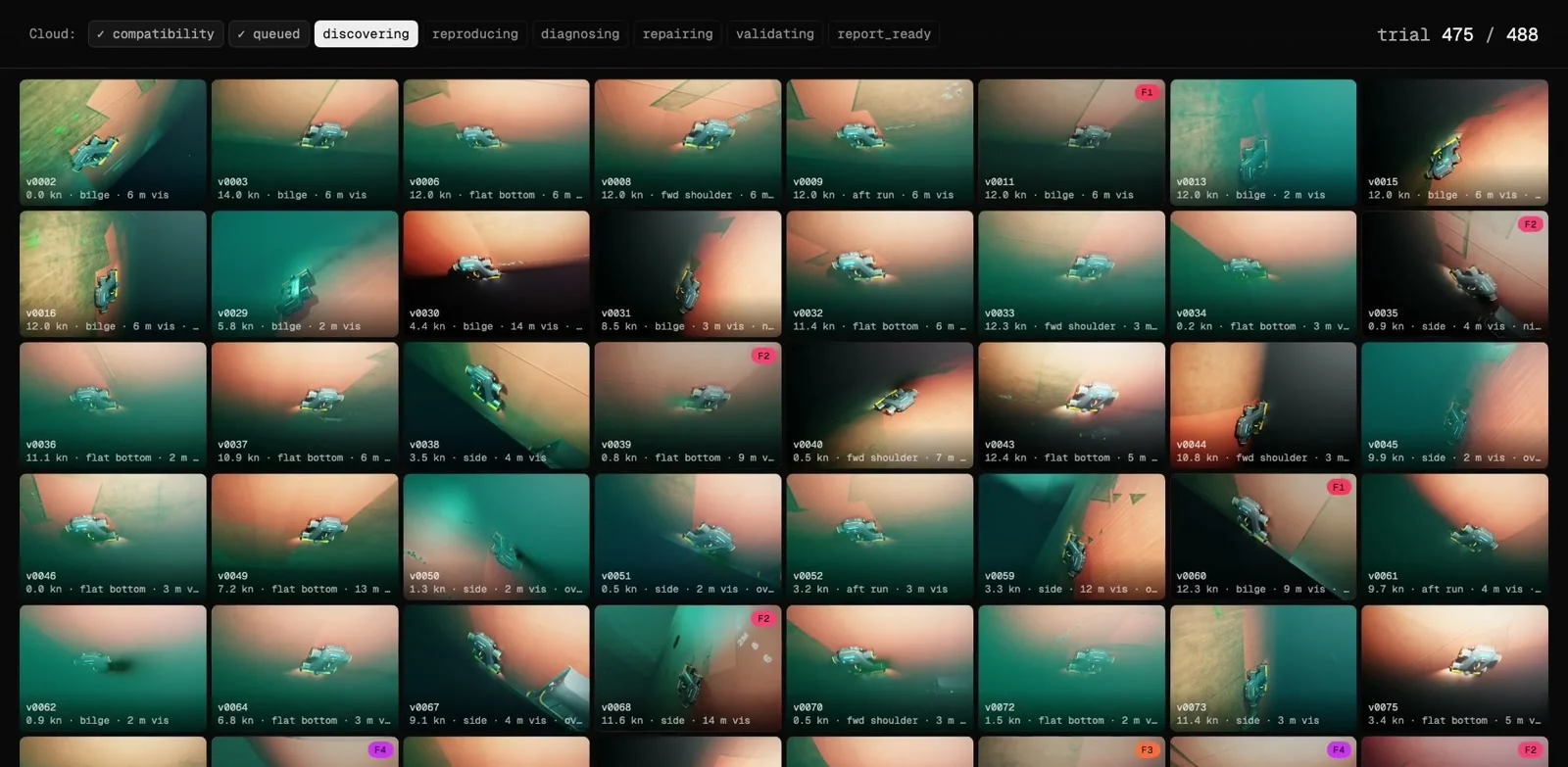
488 variations, every one judged
You approve the campaign first: trial count, held-back set, spend caps. Lighting, currents, fouling, start poses. Every variation executes, and every outcome is judged against your success criteria.
The fix, with its evidence
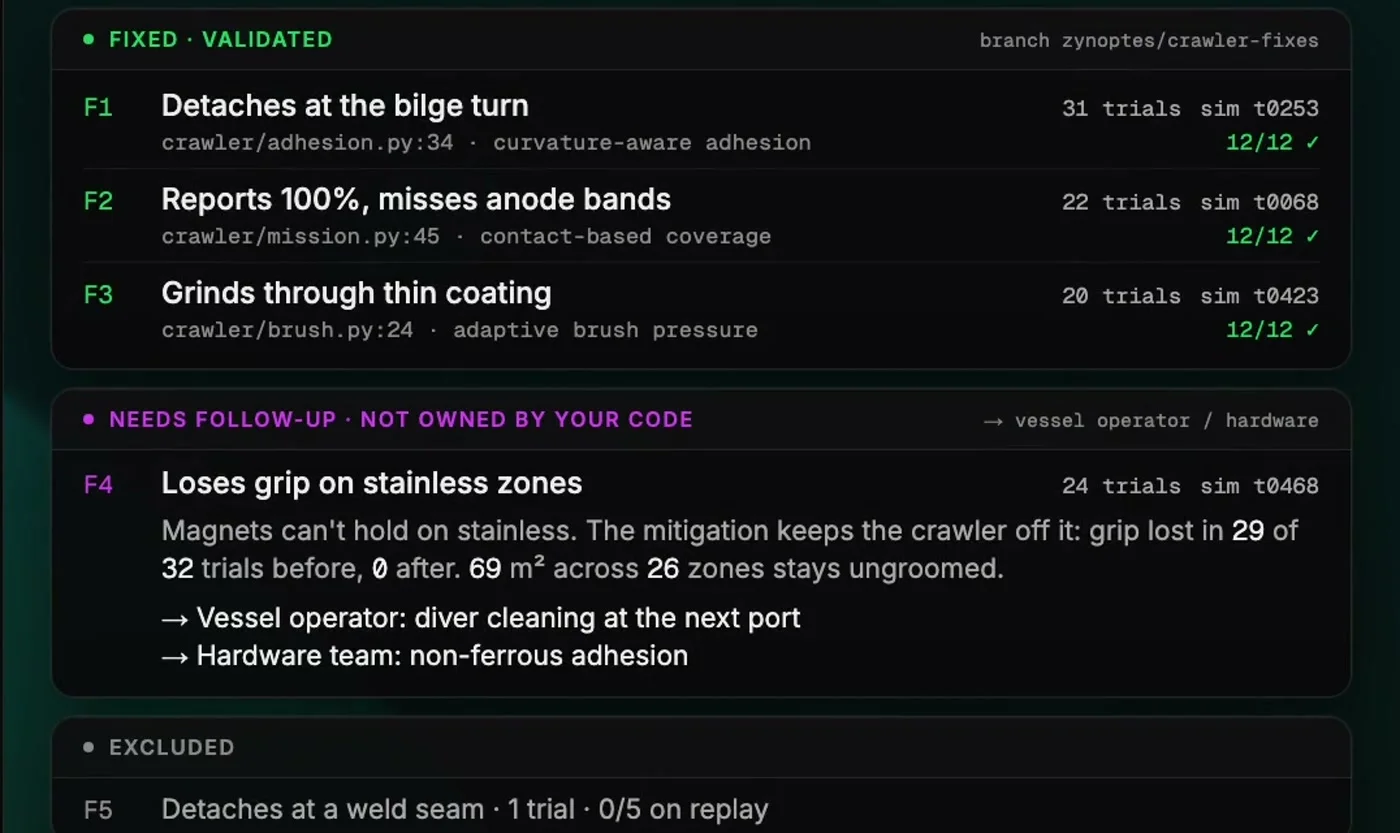
Failures come back diagnosed to the line of your code, with a proposed fix and a validation re-run. Twelve of twelve, no regressions, or it is not done. What is not yours to fix gets handed to the right owner with its evidence.
Bring one robot. We'll bring the worlds.
Can't find a time that fits? founders@zynoptes.com
Fair questions.
How is this different from Gazebo or Isaac Sim?
They're the engine; we're the engineer. Gazebo and Isaac simulate whatever world you hand them; authoring those worlds and scenarios is the expensive, manual part. ZynoCode builds what runs inside them with you, then generates the variations, executes them at scale, and judges the outcomes. We don't replace your simulator; we finally keep it busy.
Can I steer what gets tested?
That's the point. ZynoCode works like a teammate in your terminal: correct the first world as it takes shape, give it goals (“prioritize recovery behaviors”), specific scenarios (“a pallet jack left in aisle 3 at night”), or regression tests after a fix. It plans the campaign around your priorities: trial count, held-back set, and spend caps you approve before anything runs.
What counts as a failure?
Three kinds. Hard failures: crashes, detachments, timeouts. Soft failures: missed deadlines, degraded trajectories, constraint violations. And semantic failures: the run completes cleanly but the task wasn't achieved (the robot reports full coverage; the hull is still fouled). The last kind produces no error code, which is exactly why it reaches production.
What about the sim-to-real gap?
Simulation ranks and tests candidate fixes; real robot data confirms them. Scenarios are physics-grounded and domain-randomized across the matrix, so a failure has to survive variation to be reported. Every finding ships with its replay and sensor data for your team to review, and we tune for precision: a short list of real problems beats a long list of artifacts.
Is my IP used to train models?
No. Nothing is sent to us: ZynoCode runs on your own machines, and your robot descriptions, code, and scenario data are never used to train models, ours or anyone else's.
Break it before
the world does.
Spend less time building simulations and get to production faster. See where your robot fails while failures are still free.